
Thermal Imaging Surveys
Infrared Building Inspections Across the UK
Thermal Imaging Surveys — Infrared Building Inspections Across the UK
A thermal imaging survey is one of the most powerful diagnostic tools available to developers, facilities managers, and property owners. By detecting the invisible — heat loss through missing insulation, moisture trapped in a flat roof, cold bridges at structural junctions, and electrical hotspots in distribution panels — a well-executed thermographic survey can identify problems that would otherwise remain hidden until they cause serious damage, significant energy waste, or safety incidents. Stansted Environmental Services Ltd provides professional thermographic imaging surveys for residential, commercial, and industrial buildings across the United Kingdom, carried out by trained and experienced surveyors using high-resolution infrared cameras.
Since 2014 we have supported a number of clients across the construction, property, and facilities management sectors with thermal imaging services that go beyond simply pointing a camera at a wall. We analyse what the images mean, translate thermal data into clear and actionable recommendations, and provide reports that architects, engineers, warranty providers, and building owners can actually use.
What Does a Thermal Imaging Survey Detect?
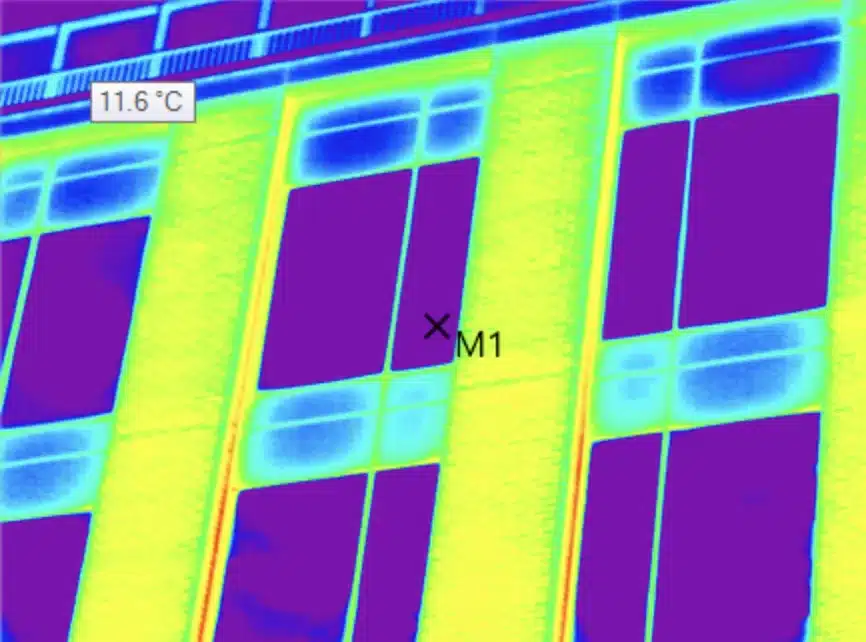
A thermal imaging survey detects variations in surface temperature across building elements, cladding systems, roofing membranes, and electrical installations. Because heat moves through and across surfaces in predictable ways, anomalies in the thermal pattern indicate departures from the expected performance of the construction or system being inspected. A cold patch in an insulated wall indicates missing or displaced insulation. A warm patch on a flat roof membrane indicates trapped moisture beneath the surface. A hot terminal in a distribution board indicates a loose connection or an overloaded circuit. A dark line at the junction of a wall and floor indicates a thermal bridge where heat is escaping through the structural element rather than through the insulation.
The survey is completely non-invasive and non-destructive. No holes are drilled, no linings are removed, and no disruption is caused to building occupants or operations. The entire inspection is carried out with the surveyor walking through the building and scanning elements with the infrared camera, a process that typically takes between two and six hours for a domestic or small commercial building and correspondingly longer for larger properties. The speed and non-invasive nature of the survey make it an extremely cost-effective diagnostic technique compared with the alternative of opening up walls, removing ceilings, or conducting intrusive investigation works.
Thermal Imaging for New Build Quality Verification
For developers of new residential or commercial buildings, a thermographic survey carried out after practical completion but before handover provides an independent verification of construction quality that can protect against future warranty claims and disputes. The survey will identify any areas where insulation has been poorly installed, a problem that is surprisingly common on busy sites where multiple trades are working in sequence and insulation is vulnerable to being displaced, compressed, or bridged by subsequent trades. It will also identify any significant air leakage paths that were not detected during the air tightness test, thermal bridges at structural junctions that were not captured by the PSI value calculations, and any areas where the external envelope shows evidence of defective workmanship.
Finding these issues before handover is far preferable to having them identified by the purchaser or their surveyor after occupation. Many NHBC and Premier Guarantee inspectors are now familiar with thermographic surveys and view them positively as evidence of a responsible approach to construction quality management.

Thermal Imaging for Existing Buildings — Diagnosis and Energy Improvement
In existing buildings, whether domestic or commercial, a thermal imaging survey provides a rapid and cost-effective baseline assessment of the building fabric’s thermal performance. For property owners and managers looking to reduce energy bills, understand the return on investment of potential insulation improvements, or identify the cause of specific problems such as cold spots, condensation, or damp, a thermographic survey provides information that simply cannot be obtained from a desk study or a visual inspection.
The survey will typically reveal the relative insulation performance of different elements of the building fabric, any areas where insulation is absent or has deteriorated, the pattern of thermal bridging at structural junctions, the location of significant air leakage paths, and the relative heat loss through different window and door openings. This information allows property owners to prioritise improvement works based on the actual performance of their building rather than assumptions, and to verify that insulation improvements carried out by contractors have actually been installed to the specified standard.
SES are a multi-disciplined environmental consultancy with a proven track record of providing high quality.
Survey Conditions and How We Plan Your Survey
For building fabric thermal imaging surveys, the quality of the thermal images is directly dependent on the temperature differential between the internal and external environment. A minimum differential of ten degrees Celsius is generally required to produce images with sufficient contrast to identify insulation defects and air leakage paths reliably. In the UK, this condition is naturally met during the autumn and winter months, making October through March the optimal survey season for building fabric inspections. During warmer months, it may still be possible to carry out useful surveys if the building is heated and the external temperature is cool, contact us to discuss the options for your specific situation and location.
Before a building fabric survey is carried out, the building should be heated to its normal operating temperature for at least twenty-four hours to allow the fabric to reach a steady thermal state. Surveys should be carried out in calm, dry conditions to minimise the effect of wind and solar radiation on surface temperatures. Our surveyors will confirm the specific survey preparation requirements for your building when booking the visit, and we will not proceed with a survey if the conditions on the day are likely to produce unreliable results.
How Much Does a Thermal Imaging Survey Cost?
The cost of a thermal imaging survey depends on the size of the building, the scope of the inspection, the travel distance to site, and the survey conditions required. For a standard new build detached house, a thermographic building fabric survey typically costs from £800 plus VAT. For a block of flats or a commercial building, surveys start from around £1200 + VAT and are priced according to the number of dwellings or the floor area. All prices include a full written report with annotated thermal images, a summary of findings, and clear recommendations for any remedial works identified.
The return on investment from a thermal imaging survey is generally very strong. A survey that costs £1,500 and identifies insulation defects that, once rectified, reduce heating bills by £200 per year pays for itself in less than eight years, and that is before the benefit of avoiding future damage from moisture ingress, condensation, or electrical failure is taken into account. For commercial and industrial clients, the financial case for regular thermal imaging as part of a planned preventive maintenance programme is even stronger.

Thermal Imaging Survey Coverage
SES provides thermal imaging surveys across London, Essex, Kent, Surrey, Hertfordshire, Suffolk, Norfolk, Cambridgeshire, and the wider South East, as well as the Midlands, the North West, Yorkshire, and all other regions of England and Wales. Surveys are typically booked one to two weeks in advance, subject to weather conditions. Emergency survey appointments are available at short notice for clients with urgent requirements.
Book a Thermal Imaging Survey
Complete our online survey request form. Please provide the property address, the type and approximate size of the building, the purpose of the survey, and your preferred survey dates, and we will confirm availability and provide a fixed-price quotation within twenty-four hours.
