
Environmental Noise Assessments
Environmental Noise Assessments for Planning Applications Across the UK
Environmental Noise Assessments for Planning Applications Across the UK
Noise is one of the most frequently cited material considerations in the determination of planning applications for new residential, commercial, and mixed-use development. The National Planning Policy Framework requires planning authorities to ensure that new development is appropriate for its location having regard to the effects of noise, and to consider the need for noise mitigation measures where development is proposed in areas affected by significant sources of noise. In practice, this means that noise assessment is required for a wide range of development types and locations, and that the quality of the noise assessment can have a direct bearing on whether planning permission is granted, and on what conditions.
Stansted Environmental Services Ltd provides environmental noise assessments for planning applications, planning condition discharge, and development management purposes across the United Kingdom. Our acoustic consultants are members of the Institute of Acoustics and are experienced in the full range of acoustic assessment work required by planning authorities and developers. We understand what local authorities are looking for in a noise assessment and we produce reports that are clear, compliant, and planning-ready.

What Is an Environmental Noise Assessment?
An environmental noise assessment evaluates the acoustic environment at a development site, identifies the sources and levels of noise present, and assesses whether the noise environment is compatible with the proposed use of the site or whether mitigation measures are needed to achieve an acceptable acoustic environment for future occupants. Environmental noise assessments are required for noise-sensitive development, housing, schools, healthcare buildings in locations affected by road traffic, rail, aviation, or industrial and commercial noise. They are also required for development that will itself generate noise industrial uses, commercial premises, entertainment venues, sports facilities where the noise from the development may affect existing noise-sensitive receivers.
The scope and complexity of the assessment depend on the nature and scale of the development, the character of the acoustic environment, and the specific concerns of the local planning authority. A small residential development adjacent to a busy road may require relatively straightforward noise monitoring and a standard BS 8233 assessment. A major mixed-use development adjacent to a freight railway line, or a new industrial estate in proximity to an existing residential area, may require extensive monitoring campaigns, detailed noise modelling, and complex assessments under multiple standards and policy frameworks.
Environmental Noise Assessment Services
01.
Baseline Noise Monitoring
Class 1 sound level meter surveys to measure existing acoustic conditions across daytime, evening, night-time, and weekend periods.
02.
BS 8233 Residential Noise Assessment
Assessment of internal and external noise levels for residential developments, including advice on glazing, ventilation, layout, and mitigation.
03.
BS 4142 Commercial and Industrial Noise Assessment
Assessment of noise from commercial and industrial sources affecting nearby residential or other noise-sensitive receiver
04.
Transport Infrastructure Noise Assessment
Noise assessment for developments near railways, motorways, airports, and other major transport infrastructure using relevant prediction methods.
Baseline Noise Monitoring
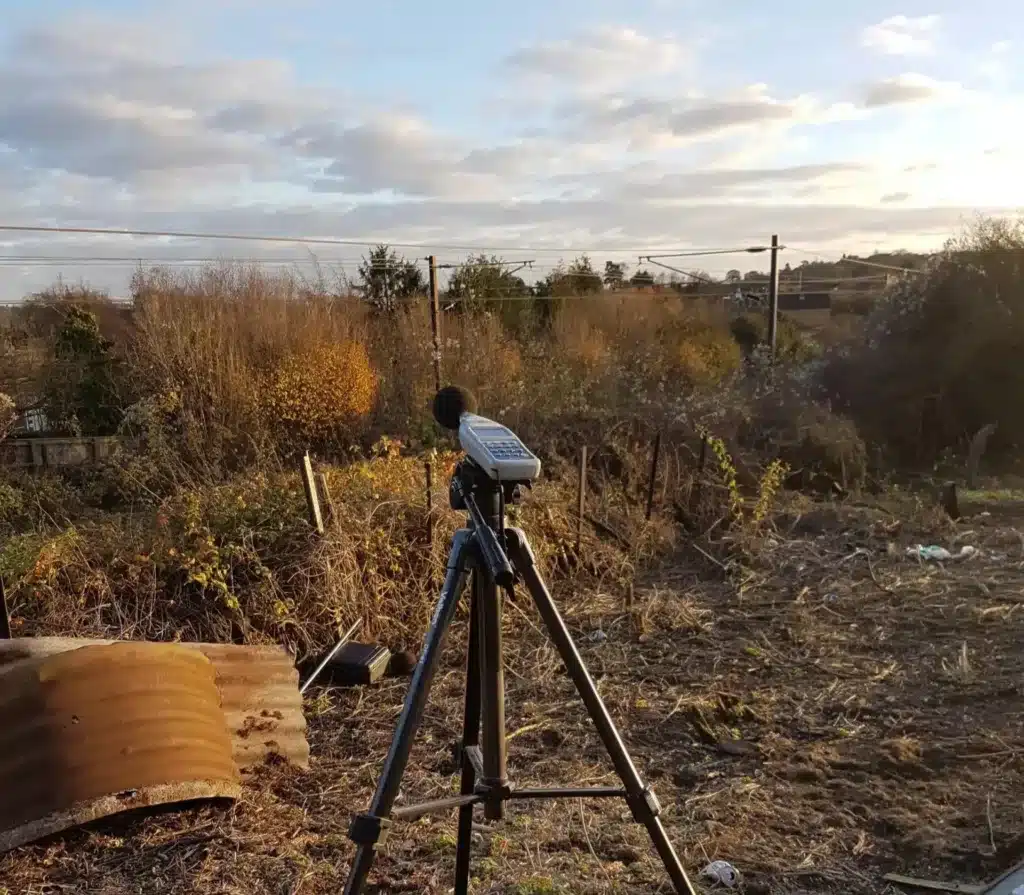
The starting point for most environmental noise assessments is a baseline noise survey to characterise the acoustic environment at and around the site. SES carries out noise surveys using calibrated Class 1 sound level meters, collecting data over periods sufficient to capture the full diurnal variation in noise levels typically including at least one weekday daytime period, one weekday evening period, one weekday night-time period and 1 full weekend period as a minimum.
The monitoring data is analysed to extract the statistical noise level descriptors required by the relevant standards and guidance. For assessments against BS 8233:2014, the key descriptor is the LAeq equivalent continuous noise level over the relevant assessment periods 07:00 to 23:00 for daytime and 23:00 to 07:00 for night-time at the facade of the proposed development. For assessments involving noise from specific industrial or commercial sources against BS 4142:2014, the LA90 background noise level and the rating level of the specific noise source are the primary descriptors.
Assessment Against BS 8233 — Residential Development
BS 8233:2014, ‘Sound insulation and noise reduction for buildings’, provides guidance on the noise levels that are considered acceptable within and around residential buildings. The standard sets out recommended indoor noise levels for sleeping rooms (35 dB LAeq,8h for the night-time period) and living rooms (35 dB LAeq,16h for the daytime period), and advises that outdoor noise levels above certain thresholds should prompt consideration of noise mitigation measures in the design of the development.
Where the existing outdoor noise level at a development site exceeds the threshold levels in BS 8233, it does not necessarily mean that the development cannot proceed — it means that the building design needs to incorporate appropriate noise mitigation to achieve the recommended internal noise levels. Common mitigation measures include the specification of acoustic double or triple glazing with ventilation via acoustic trickle vents, the use of mechanical ventilation with heat recovery to allow windows to remain closed without compromising air quality, and the arrangement of the building layout to place bedrooms and living rooms away from the noisiest facades. SES can advise on the appropriate mitigation strategy for your specific site and development type.
SES are a multi-disciplined environmental consultancy with a proven track record of providing high quality.
Assessment Against BS 4142 — Commercial and Industrial Noise
BS 4142:2014, ‘Methods for rating and assessing industrial and commercial sound’, provides a methodology for assessing the likely impact of noise from industrial and commercial sources on nearby residential and other noise-sensitive receivers. The standard compares the rating level of the specific noise source, which is the measured or predicted noise level adjusted for any acoustic character that makes it more intrusive than a neutral broadband sound against the measured background noise level at the receiver location.
A rating level that exceeds the background level by ten decibels or more is considered likely to give rise to complaints. A rating level that is five to ten decibels above the background level is considered of moderate significance, and a rating level that is at or below the background level is considered unlikely to give rise to complaints. The BS 4142 assessment is required for a wide range of commercial and industrial development types, including retail and leisure uses with mechanical plant, logistics and distribution facilities, manufacturing operations, and extraction or processing plant. SES is experienced in applying BS 4142 to all of these source types and in advising on plant specifications, operational controls, and acoustic barriers or enclosures that can reduce the rating level to an acceptable level.
Noise Assessments for Development Near Railways and Transport Infrastructure
Development near railway lines, motorways, airports, and other major transport infrastructure requires careful acoustic assessment, as these sources can produce high noise levels that vary significantly with time and require specific assessment methodologies. Railway noise assessments typically use the Calculation of Railway Noise method to predict facade noise levels at the development, taking into account the frequency, speed, and composition of rail traffic. Road traffic noise assessments use the Calculation of Road Traffic Noise method or validated modelling software. Aircraft noise is assessed using the standard contours published by the relevant airport or using aircraft noise modelling software.
SES is experienced in assessing development near all types of transport infrastructure and can advise on the relationship between assessed noise levels and the planning policies and guidance that apply to development in different noise exposure categories. Contact us to discuss your specific site and development type.

How Much Does an Environmental Noise Assessment Cost?
The cost of an environmental noise assessment depends on the complexity of the acoustic environment, the duration and nature of the monitoring required, the assessment standards applicable, and the scale of the report. For a straightforward residential development adjacent to a single noise source such as a road, an environmental noise assessment including monitoring and a BS 8233 assessment costs start from around £1,800 plus VAT. For more complex situations, multiple noise sources, BS 4142 assessments, noise modelling, or assessments for major developments, costs are higher and are quoted on a project-specific basis. Contact SES for a quotation based on your specific site and planning requirements.
Enquire About an Environmental Noise Assessment
Please provide the site address, the proposed development type, and any relevant planning correspondence or pre-application advice relating to noise, and we will advise on the scope of the assessment required and provide a quotation promptly.
