
Noise Impact Assessments
Noise Impact Assessments for Planning Applications and Condition Discharge
Noise Impact Assessments Noise Impact Assessments for Planning Applications and Condition Discharge
A noise impact assessment is one of the most commonly required technical reports in the planning process for residential and commercial development in the United Kingdom. Local planning authorities routinely request noise assessments as part of their determination of planning applications where development is proposed in acoustically sensitive locations, where new development may generate noise that affects existing receivers, or where a pre-application scoping opinion or planning policy has identified noise as a relevant material consideration.
The quality of a noise impact assessment can have a direct bearing on whether planning permission is granted and, if granted, what noise-related planning conditions are imposed. A well-prepared assessment that accurately characterises the acoustic environment, correctly applies the relevant standards, and presents clearly justified mitigation proposals gives the planning officer confidence that noise issues have been properly addressed. A poorly prepared assessment that underestimates noise levels, misapplies assessment criteria, or proposes mitigation that is not achievable will either be rejected outright or trigger requests for additional information that delay the planning decision and increase costs. Stansted Environmental Services Ltd produces noise impact assessments that are technically rigorous, planning-compliant, and written to be used not questioned.
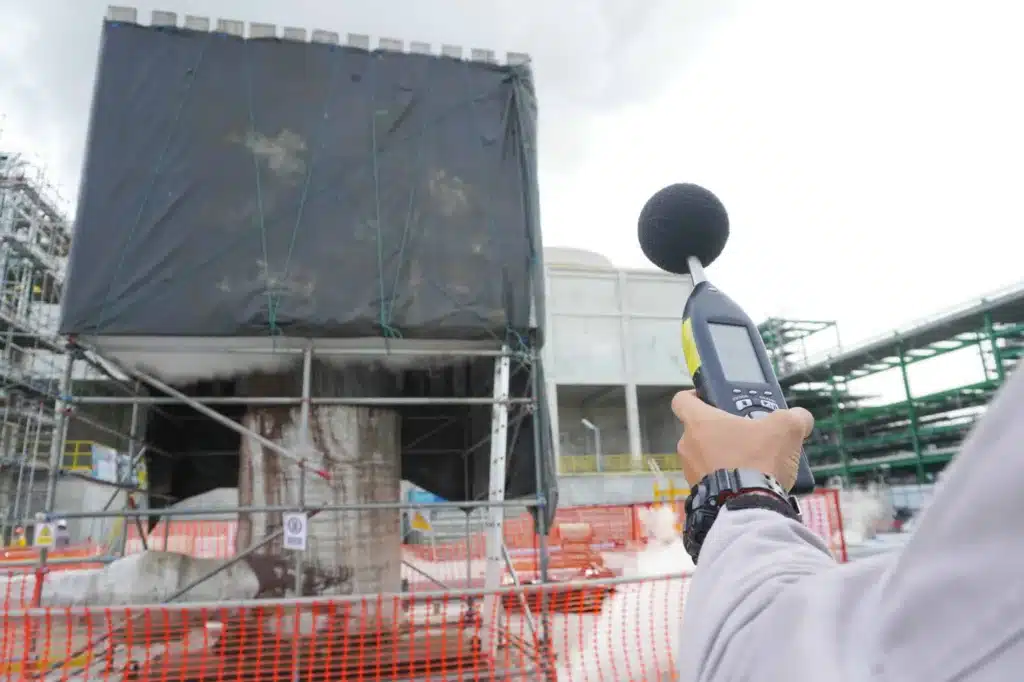
What Is a Noise Impact Assessment?
A noise impact assessment evaluates the relationship between a proposed development and the noise environment in which it is situated, or which it will itself create. For noise-sensitive development such as housing, schools, or hospitals proposed in areas affected by road traffic, rail, aviation, or industrial noise, the assessment determines whether the existing noise levels at the site are compatible with the proposed use, and what design or operational measures are needed to achieve acceptable internal and external noise conditions for future occupants. For development that generates noise, commercial premises, industrial facilities, logistics operations, leisure uses — the assessment determines the likely noise impact on nearby noise-sensitive receivers and evaluates whether that impact is acceptable or whether mitigation is required.
In most cases a noise impact assessment involves both a quantitative element measured or modelled noise levels compared against numerical criteria and a qualitative element a professional judgement about the significance of the predicted noise impact taking into account the character of the noise, the sensitivity of the receptors, and the planning context. SES assessments address both elements, presenting the quantitative evidence clearly and situating it within the relevant planning policy framework to produce conclusions that planning officers can act on with confidence.
Noise Impact Assessment Methods
01.
BS 8233:2014 Assessment
Used for residential development affected by road traffic noise, assessing facade and internal noise levels against recommended acoustic criteria.
02.
World Health Organisation Night Noise Guidelines
Used alongside residential assessments to consider night-time noise impact and sleeping room acoustic conditions.
03.
BS 4142:2014 Assessment
Used for industrial or commercial noise sources affecting residential receivers, comparing rating levels against existing background noise levels.
04.
Computer-Based Noise Modelling
Used where prediction is required, producing three-dimensional noise maps and facade noise level predictions using validated modelling software.
When Is a Noise Impact Assessment Required?
A noise impact assessment is required when a planning authority has identified noise as a material consideration in the determination of a planning application. This most commonly arises in the following circumstances: new residential development proposed in an area with significant levels of road traffic, rail, or other environmental noise; new commercial or industrial development that will generate noise affecting existing residential or other noise-sensitive receivers; mixed-use development where the different uses within the scheme may generate mutual noise impacts; and development proposed in the vicinity of operational infrastructure such as motorways, railways, airports, or industrial estates.
The National Planning Policy Framework and its associated Planning Practice Guidance require local planning authorities to take noise into account when making planning decisions, and the proliferation of Noise Action Plans and local planning policies specifically addressing noise has increased the frequency with which noise assessments are requested across all development types and regions. If you receive a scoping opinion, pre-application advice, or a validation requirement from a local planning authority that mentions noise, a noise impact assessment is almost certainly required. SES can advise on the scope and content of the required assessment on the basis of the planning correspondence and a site visit or call.

Methodology — How SES Carries Out Noise Impact Assessments
SES noise impact assessments follow the relevant British Standards and national planning guidance, with the specific methodology tailored to the nature of the noise sources and receivers involved. For residential development affected by road traffic noise, the assessment follows BS 8233:2014 and the World Health Organisation Night Noise Guidelines for Europe, using noise monitoring data and traffic noise modelling to predict facade noise levels and assess internal noise levels against the recommended criteria. For assessments involving industrial or commercial noise sources affecting residential receivers, the assessment follows BS 4142:2014, with monitoring of the existing background noise level and measurement or prediction of the specific noise source rating level.
Where noise modelling is required for example, to predict noise levels at a residential development from a complex combination of road and rail sources, or to assess the propagation of noise from a commercial development to surrounding receivers, SES uses validated computer-based noise modelling software to generate three-dimensional noise maps and facade noise level predictions. The modelling takes into account terrain, buildings, barriers, and other features of the acoustic environment that affect noise propagation, and produces results that are significantly more accurate than simple distance-based calculations.
SES are a multi-disciplined environmental consultancy with a proven track record of providing high quality.
Mitigation Design and Planning Conditions
Where the noise impact assessment identifies that the existing noise environment exceeds the criteria for the proposed use without mitigation, SES provides specific mitigation recommendations that are practical, achievable within the constraints of the development, and sufficient to achieve the required acoustic standards. For residential development affected by road traffic noise, typical mitigation measures include acoustic glazing to achieve the required internal noise levels with windows closed, acoustic trickle ventilation or mechanical ventilation with heat recovery to maintain indoor air quality when windows are closed, and acoustic barriers or landscaped bunding to reduce facade noise levels on exposed elevations.
For commercial or industrial development that generates noise affecting residential receptors, mitigation measures typically include the acoustic treatment of plant enclosures, specification of low-noise plant, restrictions on operating hours, acoustic barriers, and building layout arrangements that maximise the separation between noise-generating areas and sensitive receivers. SES advises on appropriate mitigation measures based on the specific characteristics of each site and presents them in a format that can be directly incorporated into planning conditions, making it straightforward for the local planning authority to monitor compliance during construction and operation.
Planning Condition Discharge
Many planning permissions for noise-sensitive development include a condition requiring the submission and approval of a scheme of noise mitigation measures prior to occupation, or a condition requiring noise monitoring to be carried out after occupation to verify that the mitigation is achieving the required performance. SES can prepare the documentation required to discharge these conditions, including detailed specifications of acoustic glazing and ventilation systems, noise monitoring reports, and verification that the installed mitigation is achieving the required internal and external noise standards.
Conditions relating to noise can also arise on commercial and industrial planning permissions, including conditions restricting operating hours, limiting plant noise levels, requiring acoustic assessments to be carried out before new plant is installed, and requiring noise monitoring to be carried out if complaints are received. SES can advise on the implications of these conditions for the operation of the business and can carry out the assessments and monitoring required to demonstrate compliance.

How Much Does a Noise Impact Assessment Cost?
The cost of a noise impact assessment depends on the complexity of the acoustic environment, the duration and nature of monitoring required, the scope of modelling, and the length and detail of the report required by the planning authority. For a relatively straightforward residential planning application affected by road traffic noise, a noise impact assessment including monitoring, BS 8233 assessment, and a clear planning-ready report typically costs from around £2,500 plus VAT. For more complex schemes, multiple sources, BS 4142 assessments, noise modelling, large-scale development, costs are higher and are quoted project-specifically. Please contact us for a quotation.
Request a Noise Impact Assessment
Please provide the site address, description of the proposed development, the planning authority, and any relevant planning correspondence, and we will advise on the scope of the required assessment and provide a clear fee proposal with a programme.
